Table of Contents
Cooking Over a Firepit (Propane or Natural Gas)
We all know that cooking on your wood-burning fire pit is a lovely way to make delicious food and get a bit more use out of it. But for those of us with a gas fire pit, we can’t help but ask - can I cook on a gas fire pit?
Let’s dive straight in and find out…
What type of gas is my fire pit?
First, let’s get to grips with the different types of gas fire pits that are currently on offer.
There are two primary types of gas fire pits:
Propane – also known as liquid propane is basically petroleum gas stored at high pressure (which is what makes it a liquid).
Natural gas – this is the gas you get from the mains supply. If you have a gas supply running to your house, then you will almost certainly be using it for your heating and your gas hobs.
Each type has its own pros and cons, which we have explored in a lot more detail.
Can I cook with Propane
The simple answer is you can indeed cook with your propane gas fire pit.
In fact, if you have a gas BBQ, it will most likely run on liquid propane.
Propane burns cleanly and hot, which is great for cooking, and it burns cleanly, meaning it won’t leave your food with any toxins or bad taste.

Can I cook with Natural Gas?
Similarly, a natural gas fire pit can absolutely be used for cooking. After all, it’s the same fuel that’s used for your gas hob in your kitchen.
Again, natural gas burns nicely and hot, which is ideal for food.
How to cook over a gas fire pit?
In order to cook on your gas fire pit, you’ll need to buy a few additional bits of equipment or accessories. What accessories depend on what and how you want to cook.
There are four primary ways of cooking on your fire pit. Let’s dig into them.
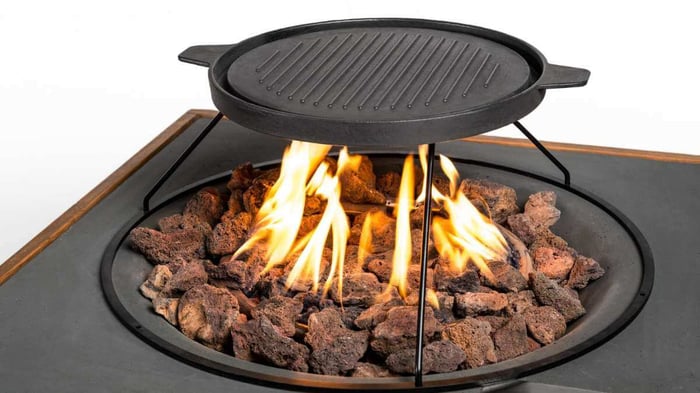
Grill – This is your classic BBQ-style grill that sits over the fire. Firepit grills are readily available, and there is every chance that your fire pit brand has its own bespoke grill. If not, then you ideally want something that is freestanding, and that you can control the height.
Rotisserie – rotisserie cooking is one of our most favourite ways to cook outdoors and on our fire pits. Slow-cooked and rotated, it’s a fantastic way to add a depth of flavour to your food.
Stick – This is your classic western movie-style cooking: a bit of food at the end of a stick, hovering above the fire. It will also no doubt make you think of toasting marshmallows. Yum!
Pot cooking – pot cooking over a fire pit is exactly as it sounds: heating a pot with the fire pit. This is ideal if you want to make a stew or a soup outside, or even push the boat out and make a nice curry.

Things to avoid when cooking on a gas fire pit
An important thing to bear in mind is that not all gas fire pits are designed to be used for cooking.
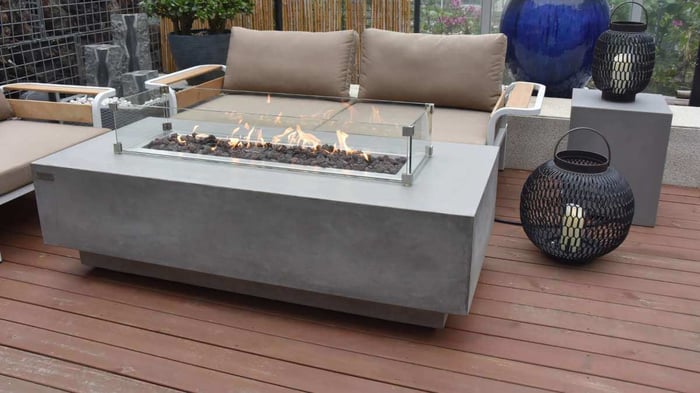
Many gas fire pits come with additional features or designs, such as lava rocks, faux wood, safety shields, etc. All of these will make cooking on your gas fire pit more difficult.
The key to cooking on your fire pit is getting the food close enough to the heat source. For some fire pits, this just isn’t possible (though if all you want to do is toast a marshmallow or two, then you shouldn’t have a problem!).
On top of that, if there is one thing that you want to avoid at all costs is getting any sort of food, liquid, or any sort of residue on your gas fire pit’s valves. This isn’t necessarily an easy thing to do if you are cooking directly over the fire.
Why do you want to avoid this? There are a couple of reasons:
- Your valves may get clogged, which will reduce the heat from your fire and decrease its efficiency. For natural gas and propane, there is also the worry that the fuel is not burned efficiently, which in turn produces carbon monoxide, which can be very dangerous when it builds up in enclosed spaces of any sort.
- Hard to clean off – food and residue hitting the fire source will be very hard to clean off as it will be scorched onto the metal.
Final Thoughts
As we said above, fire is fire at the end of the day, and using the flame from your gas fire pit is fine for cooking.
Depending on your fire pit's design, cooking might be easier or harder. If you have a simple open fire, however, you shouldn’t have any problems and will be able to find plenty of accessories to help you turn your gas fire pit into a versatile outdoor kitchen.
Of course, if you’re looking for that authentic BBQ flavouring that comes from the smoke of burning a good hardwood, then a gas fire pit won’t give you that, sadly, but you can’t always have everything!
FAQs
Should I remove the lava rocks or fire glass before cooking?
It's usually best to leave the media in place. Lava rocks and fire glass help distribute heat evenly and protect the burner from drips, so removing them exposes the valves to spills and can create uneven hot spots. If the media sits too high and stops you from getting close to the flame, choose a taller freestanding grill rather than stripping the pit back.
What cookware is safe to use over a gas fire pit?
Cast iron is the most reliable choice. It handles high, direct heat without warping and holds temperature well for searing or slow pot cooking. Avoid non-stick pans, which break down at fire pit temperatures, and thin enamelware, which can crack or chip. A heavy cast iron skillet, Dutch oven or a stainless rotisserie kit will cover most outdoor cooking.
Will cooking shorten the life of my gas fire pit?
It can if you're not careful, though sensible use causes little harm. The main culprits are grease reaching the burner and acidic foods or salt left sitting on metal surfaces, both of which accelerate corrosion. Wiping down surfaces after each use, keeping spills off the valves and storing the pit under a cover will keep it in good condition for years.